

Product dryness is a determining factor in the pro-
cessing of many products including paper, wood and
textiles. Quality control relies on being able to quick -
ly determine when the products are sufficiently dry.
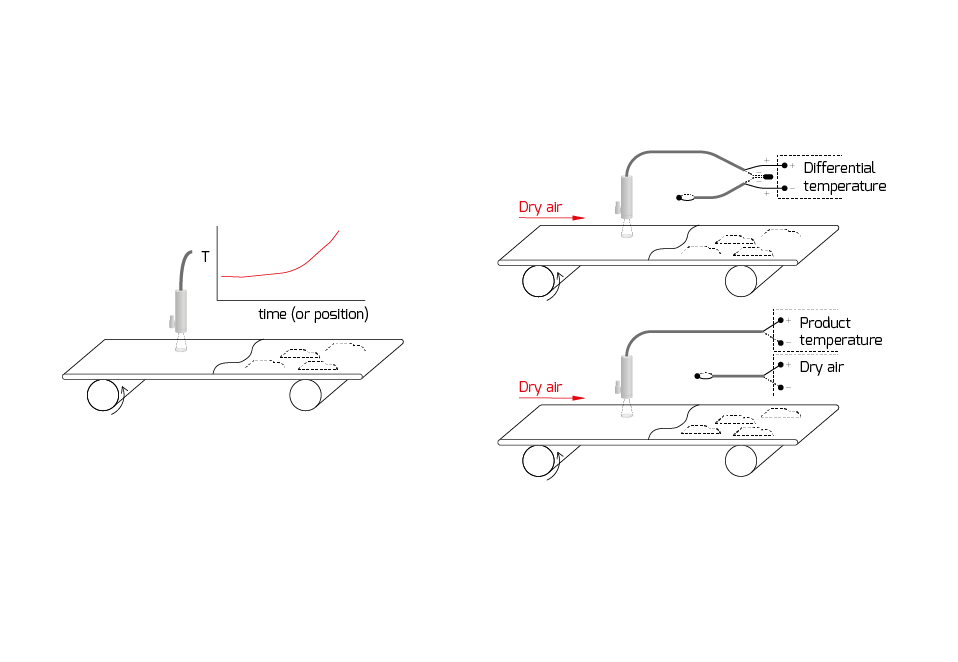
The surface temperature of a ‘wet’ product rises
very slowly as constant heat is applied. This occurs
because the moisture in the product absorbs much
of the heat energy as it evaporates. At the point that
the product becomes ‘dry’ however, the same con-
stant heat will quickly raise the temperature. This
continues until the surface reaches the same tem-
perature as the surrounding air, or higher if the heat
source is radiation. If temperature vs. time is plotted
for a heated drying process, the target ‘dry’ tempe-
rature point can clearly be seen as the beginning of
a rapid rise in surface temperature.
IRt/cs can be used to monitor these changes in sur -
face temperature. With their fast 0.05–0.2 second
response time, IRt/cs can quickly detect when the
surface temperature begins to rise rapidly. This is an indication that the products have reached a low
moisture content. (See also T ech Note No. 45)
A simple implementation method is to measure the
difference in temperature between the product and
the ambient air. T o do this, determine the delta T that
results in the correct dryness, then set the control
system to maintain that delta T.
The IRt/c is particularly convenient because it can be
wired differentially with an ordinary thermocouple.
The combined signal can be fed to a single control
channel. Alternatively, if absolute temperature is
preferred, the IRt/c and thermocouple can be read
and controlled independently.
For hot, humid, dusty environments, the IRt/c.3x is
recommended because of its small size and super-
efficient air purge system. Fully developed, patented
IRt/c-based drying systems are available. Contact
CleverIR for referrals.