

Emissivity is a surface property which determines
how much radiation an object emits at a given
temperature compared to a blackbody at the same
temperature. Emissivity (along with background
thermal radiation) is a primary source of errors in
infrared temperature measurement. Emissivity
can be more easily understood when we consider
infrared’s similar properties to visible light.
Mirrors figure prominently in the discussion of
heat radiation and emissivity. Since heat and light
radiation behave similarly, what we see with our
eyes is similar to what the IRt/c sees.
When you look into a mirror with your eyes, you see
only reflections, nothing of the mirror itself. If the
mirror is perfect, it has 100% reflectivity. Therefore,
it emits nothing because it reflects everything.
For this condition, the emissivity is zero.
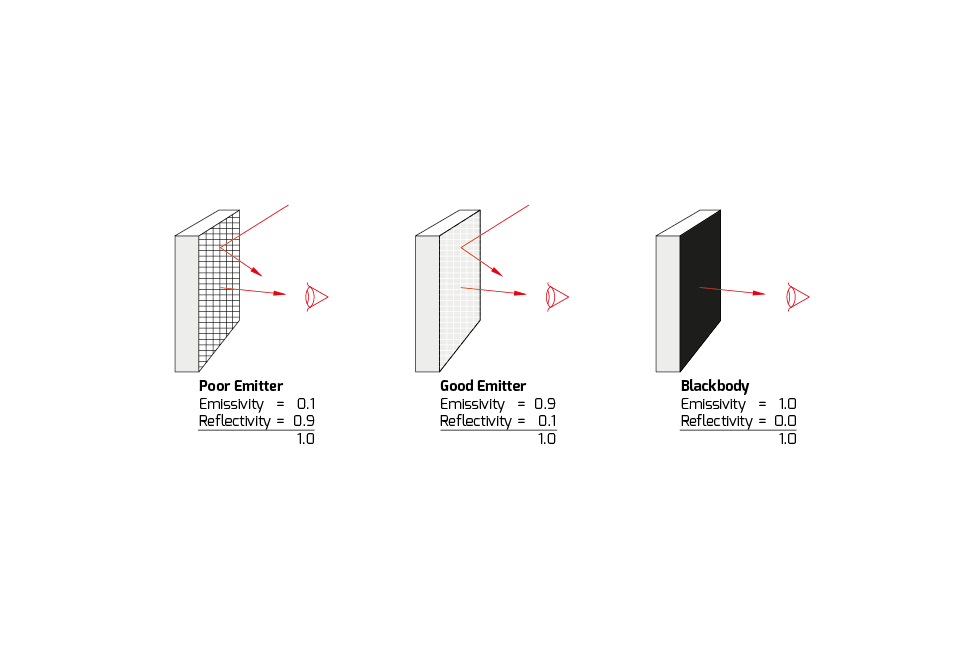
If we consider an imperfect mirror, the eye then sees
mostly reflection, but also some of the imperfections
on the mirror’s surface. If for example we see 90% of
the mirror as a perfect reflector and 10% as imper -
fections, 90% of the mirror reflects; the remaining
10% emits. Therefore, the emissivity equals 0.1.
Consider for a moment the exact opposite of a per -
fect mirror, which is a perfect emitter. The eye looks at a perfect emitter and sees no reflection at all, only
the emitting surface. Since 100% of the surface emits,
and 0% reflects, the emissivity equals 1.0. This type of
object is called a blackbody.
Finally, consider a good emitter. The eye sees a small
amount of reflection interspersed with the large
amount emitting. If 10% of the surface does not emit,
and instead reflects, we have 10% reflecting and the
remaining 90% emitting. Therefore, the emissivity
equals 0.9.
Accordingly, we can state the following rule of
emissivity:
The emissivity of a surface is simply the percentage of
the surface that emits. The remaining percentage of
the surface reflects.
Shiny metal surfaces act like mirrors, with emissi-
vities in the range 0.05 to 0.2. Accordingly, they have
only 4% to 25% emitting area compared to reflecting
area, and for that reason are difficult to measure with
infrared methods. Non-metals, organic materials, and
coated metals have emissivities in the range of 0.8
to 0.95 and thus have 400% to 1,900% emitting area
compared to reflecting area, and thus are much more
easily measured successfully.
Poor Emitter
Emissivity = 0.1
Reflectivity = 0.9
1.0Good Emitter
Emissivity = 0.9
Reflectivity = 0.1
1.0Blackbody
Emissivity = 1.0
Reflectivity = 0.0
1.0